Environmental protection damping pad for vehicle发布日期:2020-02-12
Environmental protection damping pad for vehicle
purpose:
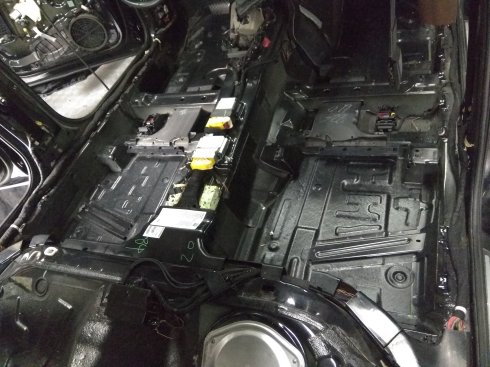
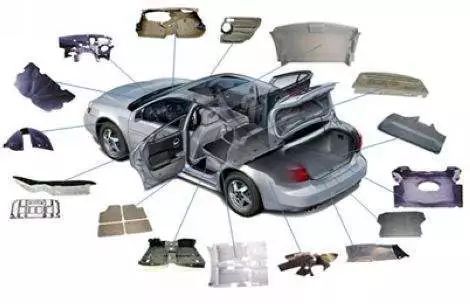
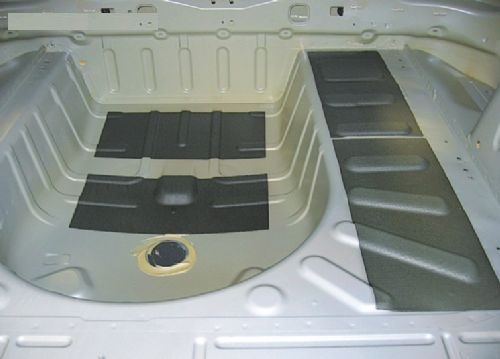
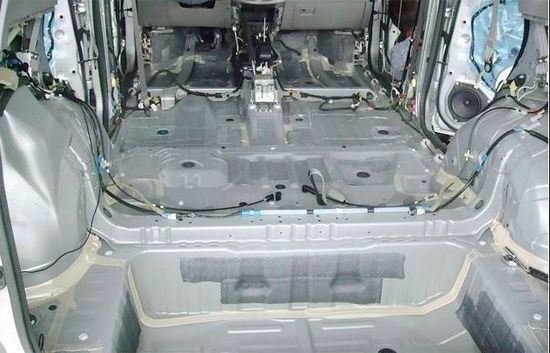
According to the sources of automobile noise, different automobile sound insulation materials are used, such as doors, roofs, windows, underbody panels, rear tailboxes, engine covers and other parts that are prone to generate automobile noise, and some sound insulation and shock absorption materials are installed.
Material butyl rubber
Butyl rubber is a kind of polymer composed of isobutylene and isoprene which polymerize at - 100 ℃, with excellent stability and non degradation and non volatilization
1. Permeability: the dispersion speed of gas in polymer is related to the thermal activity of polymer molecules. The side methyl in butyl rubber molecular chain displays intensively, which limits the thermal activity of polymer molecules, so the permeability is low and the air tightness is good.
2. Heat invariance: butyl rubber vulcanizate has excellent heat invariance. Sulfur vulcanized butyl rubber can be used in the air for a long time at 100 ℃ or slightly lower temperature, and resin vulcanized butyl rubber can be used at 150 ℃ ~ 200 ℃. Butyl rubber has excellent stability.
3. Energy absorption: butyl rubber has short double bonds in its molecular structure, and the side chain methyl has a large dispersion density, so it has the characteristics of superior receiving vibration and impact energy. Within a wide temperature limit (- 30~-50℃) the rebound characteristics of butyl rubber are not more than 20%, which clearly shows that the ability of receiving mechanical function of butyl rubber is better than other rubbers. The damping property of butyl rubber at high deformation speed is inherent in the polyisobutylene chain segment, and it is not affected by the application temperature, unsaturation degree, vulcanization shape and formula change in the flood degree. Therefore, butyl rubber was an ideal material for sound insulation and vibration reduction at that time.
4. Low temperature property: the spatial structure of butyl rubber molecular chain is spiral. Although there are many methyl groups, each pair of methyl groups scattered on both sides of the spiral are staggered at an angle with each other, so the butyl rubber molecular chain is still quite gentle, with low glass transition temperature and good elasticity.
5. Durability: the high saturation of butyl rubber molecular chain makes it have high ozone resistance and weather aging resistance. Ozone resistance is about 10 times higher than that of SBR.
6. Stable: the high saturation structure of butyl rubber makes it have high chemical invariance. Butyl rubber has excellent corrosion resistance to most inorganic acids and organic acids. Although it is not resistant to concentrated oxidizing acids, such as nitric acid and sulfuric acid, it is resistant to non oxidizing acids and moderate concentrations of oxidizing acids, as well as alkali solutions and oxidation recovery solutions. After soaking in 70% sulfuric acid for 13 weeks, the strength and elongation of butyl rubber almost did not lose, while the function of natural rubber and SBR had declined severely.
7. Electric function: the electric insulation and corona resistance of butyl rubber are better than that of plain rubber. The volume resistivity is 10-100 times higher than that of plain rubber. The dielectric constant (1kHz) is 2-3, and the power factor (100Hz) is 0.0026.
8. Water resistance: the water permeability of butyl rubber is very low, and its water absorption at room temperature is lower than that of other rubber, only 1 / 10-1 / 15 of the latter.